 Appleak
Copy an Ad: Take the Structure, Keep Your Own Words
The problem: you need ads that work, and testing from nothing is slow and costly. Your rivals have already paid to learn which hooks hold. Appleak shows you their ads that keep running and reads each one, so you can take the structure that works and fill it with your own app, creator and words.
In short
- 01Find the ads that keep running: time live and many versions of one hook are the public signs that an ad works.
- 02Read each one for its hook, angle, offer and format. That structure transfers; the copy and the footage do not.
- 03Ad Search finds a category’s ads on six networks and reads every one, so the work is choosing, not watching.
By Appleak · 21 Nov 2026
The problem
A new ad account spends its first budget learning what a rival already knows: which promise makes people stop scrolling, and which offer gets the install. Watching rivals’ ads by hand, one network and one advertiser at a time, takes days, and the ads that look good are not always the ones still running.
What copying means here: the structure, not the ad. The order of hook, proof and offer is a pattern anyone can use. Another app’s words, footage, creators and brand belong to it.
The steps in Appleak
- Search the category. In Ad Search, type the kind of app, or ask “show me ads for calorie trackers”.
- Choose the networks. Meta and TikTok cost credits, priced before they run; Google, YouTube, Apple and Snapchat cost nothing.
- Look for what keeps running. Meta ads show their days live. The ones running for weeks are the ones being paid for.
- Open an ad to read it. Its hook, angle, call to action, offer and format are read out, with the days it was first and last seen.
- Group what you find by angle. Three apps leading with the same promise tell you what the category believes works.
- Write your own brief. Keep the structure of the strongest two or three: the kind of hook, the proof, the offer. Fill it with your app, your creator and your words.
What you see
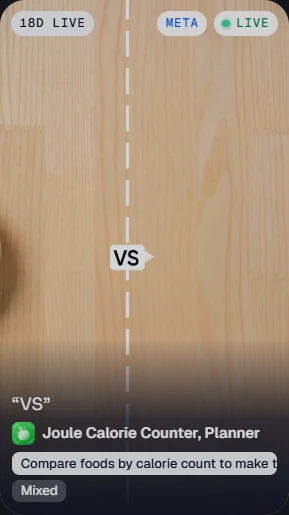
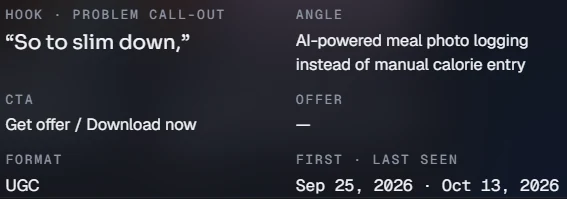
Read as a structure, the second ad is: a problem called out in the first words, an angle of logging meals from a photo instead of by hand, and a call to action to claim an offer. That pattern can carry a different app and different words.
A real example: one hook, scaled
What one advertiser keeps paying for
On 8 Oct 2026, Cal AI had 28 Meta ad creatives. 19 of them led with the same headline, “Limited Time Free Trial 👉”, first shown 18 May 2026 and still running that day. 24 used the same line of body text: “AI can now count your calories—just from a photo.”
What to take from it: a free-trial offer in the headline, run across most of an advertiser’s creatives for months, is a promise this audience answers. What to leave: the headline itself, the footage and anything that would make your ad look like theirs.
Limits, honestly
- No spend or results. No network publishes them for ordinary ads, so time live and repeats are signals, not proof.
- Days live come with Meta ads; the other networks’ ads come without the same run history.
- Matching an ad to an app is not exact, and where Appleak could not confirm a match it says so.
- It shows what rivals run, not what will work for you. Test your own versions.
- Some formats rest on a creator’s face and voice; you will need a creator of your own to use them.
Questions
Is it legal to copy a competitor’s ad?
Reusing another ad’s script, footage, music or brand can infringe its owner’s rights and break the platforms’ rules. Learning from its structure, the kind of hook, proof and offer it uses, is ordinary practice. This is not legal advice.
What is the structure of an ad?
Its parts in order: the hook in the first line or two seconds, the angle or reason to care, the proof, the offer and the call to action, and the format that carries them, such as a creator to camera or a screen recording.
How do I know which competitor ads are working?
Look at how long each has run and how many versions share its hook. An ad live for weeks, or one idea spread across many creatives, is one the advertiser keeps paying for.
Can I watch the whole ad, not just read its hook?
Yes. Ads play where they are, with their parts read out beside them. Appleak keeps no copy of other people’s ads.
Which network should I learn from first?
The one you will advertise on. Meta shows how long each ad has run, which makes it the easiest place to see what keeps going; TikTok shows the creator-style formats.
Read next
See the ads your rivals keep paying for.
Name a kind of app. Appleak shows its ads with each one’s hook, angle and format read out.
show me ads for calorie trackers